
Lactobacillus reuteri has been studied for several possible health effects, but the findings depend on the specific strain and condition. Human research is most developed for infant colic, support during H. pylori treatment, acute diarrhea in children, gum health, and bone density in older women.
Those results don't mean every product labeled L. reuteri will have the same effects. We'll look at what the studies show, where the evidence is limited, and why strain details matter.
Key Takeaways
- Lactobacillus reuteri, renamed Limosilactobacillus reuteri in 2020, is a species; reported effects depend on the specific strain.
- Human studies suggest strain DSM 17938 may reduce crying in some infants with colic, but results don't apply to every infant or probiotic. Review of infant-colic trials
- In children, DSM 17938 may shorten acute diarrhea; during H. pylori treatment, evidence suggests fewer antibiotic side effects, not proven eradication. Updated pediatric review
- Small studies tested DSM 17938 with ATCC PTA 5289 as an addition to periodontal care. ATCC PTA 6475 has also been studied for bone loss in older women. Periodontal review Bone-density trial
- Homemade yogurt and claims about oxytocin, skin, testosterone, or weight loss aren't established human benefits; ordinary yogurt may not contain a studied strain or dose.
What Is Lactobacillus reuteri, and Why Was Its Name Changed?
Lactobacillus reuteri is a species of probiotic bacteria. "Probiotic" describes live microorganisms that can benefit health when used in appropriate amounts, but the evidence depends on the specific strain and the outcome studied.
Why the scientific name changed
In 2020, researchers revised the classification of the large Lactobacillus genus after comparing bacterial traits and genetic data. As a result, Lactobacillus reuteri was reassigned to a new genus and renamed Limosilactobacillus reuteri. The research on Limosilactobacillus classification describes this broader taxonomic revision.
The name change updated how scientists group the bacterium. It did not create a new organism or change the findings from earlier studies. You may still see Lactobacillus reuteri on older papers and product descriptions, while newer scientific writing may use Limosilactobacillus reuteri.
Why strain names matter
A species can contain many distinct strains, which are identified by codes such as DSM 17938 or ATCC PTA 6475. These strains can differ in their characteristics, so a result from one strain cannot automatically be applied to another.
For example, research on infant colic often focuses on DSM 17938, while a bone-density study in older women examined ATCC PTA 6475. Therefore, when assessing potential Lactobacillus reuteri benefits, check both the strain and the health outcome studied. A product that lists only the species name does not show that it contains a strain tested for a particular benefit.
Lactobacillus reuteri Benefits: What Human Research Shows
Human evidence for L. reuteri is tied to particular strains and groups of people. These findings don't establish benefits for every strain or probiotic product.
Infant colic: findings for strain DSM 17938
A systematic review found moderately strong evidence that L. reuteri DSM 17938 may shorten crying time in some infants with colic. However, results varied across settings, so they may not apply to every infant. The systematic review of infant colic evaluated this specific strain, not L. reuteri products as a whole.

H. pylori treatment support: what DSM 17938 may add
An updated review found that DSM 17938 may help reduce side effects linked to H. pylori antibiotic treatment. It reported only a tendency toward higher eradication, which does not prove the probiotic removes the infection. The updated review of DSM 17938 discusses it as a possible addition to treatment, not a replacement for prescribed medication.
Acute diarrhea in children: evidence for DSM 17938
The same review found that DSM 17938 may shorten acute diarrhea or hospitalization in children with acute gastroenteritis. However, it did not show benefit for preventing antibiotic-associated or hospital-acquired diarrhea. These findings apply to children and should not be extended to adults.
Gum health: studies of DSM 17938 with ATCC PTA 5289
Many gum-health studies used DSM 17938 together with ATCC PTA 5289, given alongside a professional deep cleaning (scaling and root planing). A 2023 systematic review of nine studies with 287 adults found that most reported better gum measurements with the probiotic than with cleaning alone. The studies were small and varied, though, so the results should be read with caution. Probiotics don't replace periodontal treatment.
Bone density in older women: the ATCC PTA 6475 trial
In a 12-month randomized, placebo-controlled trial, 90 women aged 75 to 80 with low bone density took either ATCC PTA 6475 or a placebo. Those taking the probiotic lost less bone at the shinbone (tibia), the trial's main measure. Other bone measures moved in the same direction, but those differences were not statistically significant. The trial report calls for more research and does not show that this strain prevents fractures or osteoporosis.
Popular L. reuteri Claims That Need Better Evidence
Online claims often go beyond the human research. Homemade yogurt, hormone changes, clearer skin, and weight loss are not established Lactobacillus reuteri benefits, and results from one strain cannot prove effects from another.
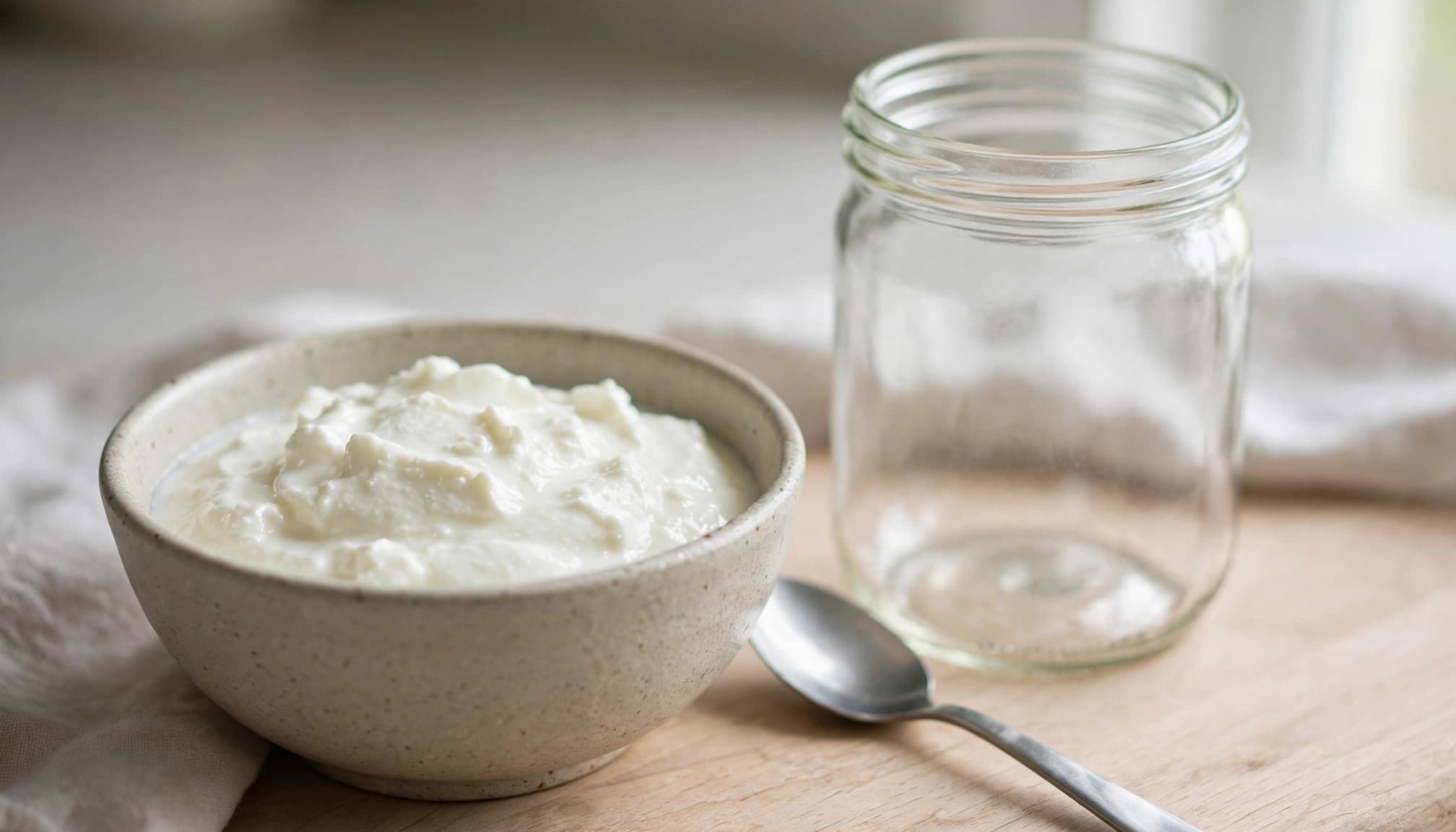
Homemade L. reuteri yogurt is not a tested clinical product
Homemade fermented yogurt may contain live bacteria, but the finished product's strain identity and bacterial count aren't confirmed by clinical testing. That makes it different from the defined preparations used in studies, which specify strains such as DSM 17938 and ATCC PTA 5289. Typical store-bought yogurt also shouldn't be assumed to contain a studied L. reuteri strain.
Oxytocin, skin, and testosterone claims remain preliminary
Claims that L. reuteri raises oxytocin or improves skin rely largely on early or nonclinical research, not strong human evidence showing a reliable health benefit. A small 2026 pilot study gave ATCC PTA 6475 to 10 adults aged 50 to 69 for 12 weeks and found no notable change in sex hormones. With so few people and no placebo group, it can't show that the probiotic caused the other changes it measured, and it is not evidence of a testosterone benefit.
Weight-loss results don't generalize
A study of strain LR-99 examined body-mass outcomes in people with Prader-Willi syndrome, a specific medical condition. Those results don't show that L. reuteri causes weight loss in the general population. The LR-99 study in people with Prader-Willi syndrome also cannot be applied to other strains or homemade preparations.
For each claim, look for controlled human trials that identify the exact strain and measure a meaningful outcome. Until stronger evidence exists, these popular uses should be treated as unproven.
Food Sources and Supplements: What to Know in General
Food and supplements can contain different microorganisms, so neither should be assumed to provide the strain or amount used in a study. For Lactobacillus reuteri benefits, the strain name matters as much as the species name.

Fermented foods don't guarantee L. reuteri
Yogurt and other fermented foods can contain live microorganisms, but typical store-bought yogurt isn't a reliable source of L. reuteri. Its starter cultures may include other bacteria, and fermentation alone doesn't confirm which strains remain in the finished food. The NIH overview of probiotics notes that probiotics occur in some fermented foods, added foods, and supplements.
Even when a food contains live cultures, you can't assume it provides DSM 17938, ATCC PTA 6475, or another strain studied in people. Homemade L. reuteri yogurt also hasn't been shown to match the strain identity or live-cell count of preparations used in clinical trials.
What supplement labels can tell you
A label may identify the strain and list the number of colony-forming units (CFUs), a measure of viable microorganisms. Check whether it names a specific strain, rather than only L. reuteri, and whether the CFU amount is stated. However, a label can't show that a product will produce the same result as a clinical study. Study outcomes depend on the tested strain, preparation, population, and health condition.
Therefore, supplements and fermented foods differ in strain, live-cell count, and preparation. Neither should be treated as a substitute for prescribed care.
Safety and Who Should Check With a Doctor
Probiotics are generally tolerated by healthy people, but that doesn't make every Lactobacillus reuteri product appropriate for everyone. Safety can depend on the strain, product, and a person's health, so discuss use with a clinician when you have added medical risks.

When to get medical guidance first
Check with a doctor or pharmacist before taking a probiotic supplement if you are pregnant, have a weakened immune system, or are seriously ill. The NIH overview of probiotic safety notes that safety questions can be more important for people with serious health problems. In rare cases, probiotics have been linked to infections, so people at higher risk should not assume a supplement is harmless.
Caregivers should also ask a pediatric clinician before giving L. reuteri to an infant. This is especially important for premature infants or babies with significant medical conditions. Although DSM 17938 has been studied for infant colic, evidence of a possible benefit doesn't establish that every infant or product is suitable.
Consider medications and the product itself
If you take prescription or over-the-counter medication, ask a qualified clinician or pharmacist whether a probiotic is appropriate alongside it. This is particularly relevant when a supplement is being considered during treatment for an infection or another health condition. Don't use L. reuteri in place of prescribed treatment, including medication for H. pylori.
Also, the species name alone doesn't tell you whether a product matches a clinical study. Strains and preparations differ, and evidence for one strain doesn't establish the safety or effects of another. Bring the product label to your appointment so your clinician can review its ingredients and strain information.
Frequently Asked Questions
The main takeaway is that Lactobacillus reuteri research applies to specific strains and outcomes, not every probiotic product. These answers clarify how to interpret the name, study results, and treatment claims.

Does the name change mean L. reuteri is a different bacterium?
No. In 2020, researchers revised the genus classification, changing Lactobacillus reuteri to Limosilactobacillus reuteri while keeping the species name reuteri. The research on the genus reclassification explains the update; older studies and some labels may still use the former name.
Are all L. reuteri strains expected to work the same way?
No. Probiotic effects depend on the strain and the health outcome researchers measured. A finding for DSM 17938, or for a blend such as DSM 17938 with ATCC PTA 5289, doesn't prove another strain will have the same effect. A review of strain-specific probiotic evidence discusses why results don't automatically transfer between strains.
Can L. reuteri replace medicine for H. pylori or diarrhea?
No. Evidence suggests DSM 17938 may have an adjunct role in certain settings, such as reducing some antibiotic-related side effects during H. pylori treatment or supporting care for acute diarrhea in children. It should not replace prescribed treatment or appropriate rehydration. See the pediatric evidence review for the limits of these findings.
Is homemade L. reuteri yogurt proven to provide the studied benefits?
No. Homemade preparations haven't been established as equivalent to clinical trial products because their strain identity, live-cell count, and preparation can differ. So, a recipe can't confirm that the finished yogurt delivers the product studied or the same health outcome.
How can I tell which strain a study tested?
Look for the strain identifier in the study's methods or supplement details, such as DSM 17938 or ATCC PTA 6475. The species name alone doesn't identify the strain, so it isn't enough to match a study's results to a product.
Conclusion
The clearest Lactobacillus reuteri benefits are tied to specific strains and study groups, including DSM 17938 in some infant and pediatric studies, and two-strain preparations tested alongside periodontal care. These findings don't establish the same effects for every strain or product.
Popular claims about homemade L. reuteri yogurt, oxytocin, skin, testosterone, and weight loss remain unproven or lack strong human evidence. Weigh each claim against the research, and discuss supplement use with a qualified health professional.
This article is for general information and is not medical advice. Talk to your doctor or pharmacist before starting a supplement, especially if you are pregnant, have a health condition or take medication.